
Container Docking Station
With the Container Docking Station, you can manage your containers independently from the trailer or chassis, swap them directly at your own site, and structurally decouple transport, storage, and handling.
4 Use Cases
1. Simple Drop-Off
Make containers and trailers independent of each other.
2. Drop & Swap – Hub & Spoke
Flexible, efficient separation of long-distance transport and local distribution
3. Drop & Swap –
Interim storageFlexible delivery and collection of containers with no waiting times due to decoupled processes.
4. Drop & Connect
Precise and consistent container positioning for safe and efficient loading and unloading processes.
Store, pick up or exchange containers flexibly
With the Container Docking Station, you save on terminal and trailer costs, increase your vehicle utilisation, gain operational autonomy, and create a scalable, certified system for secure and flexible container logistics.
The container docking stations are DEKRA-certified up to 34 tonnes, seismically designed in accordance with DIN EN 1998-1 (Eurocode 8), and can be operated independently by drivers. The drop-off or collection of a container, including entry and exit, only takes 5–10 minutes.
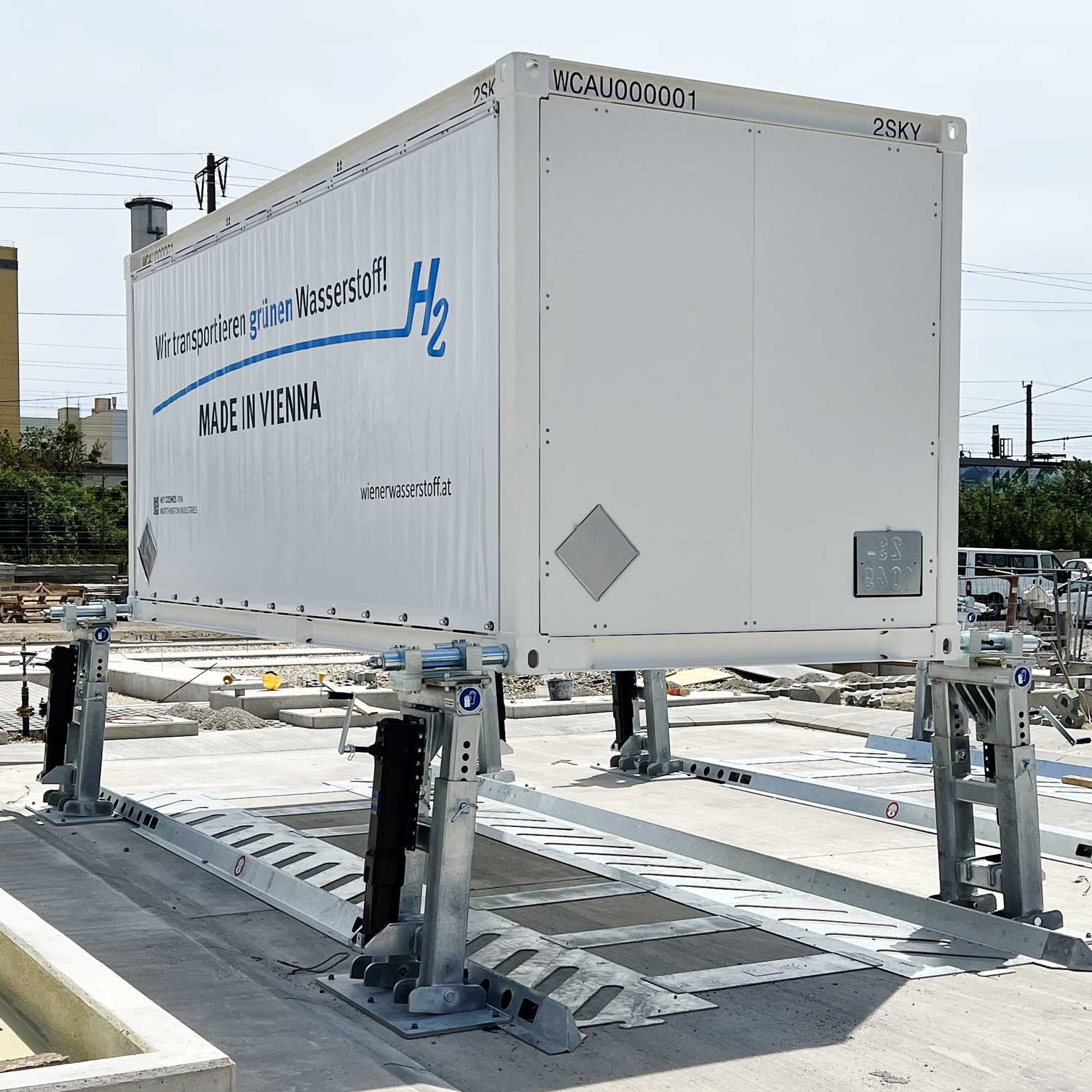
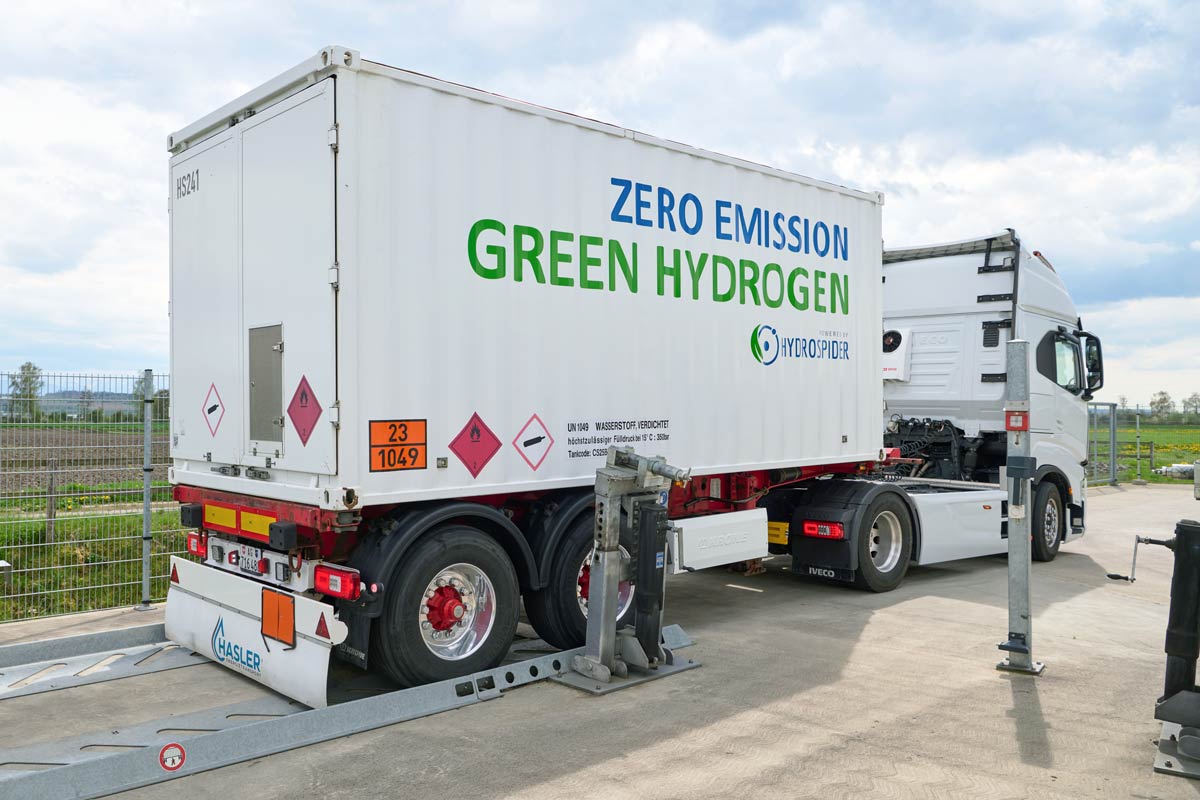
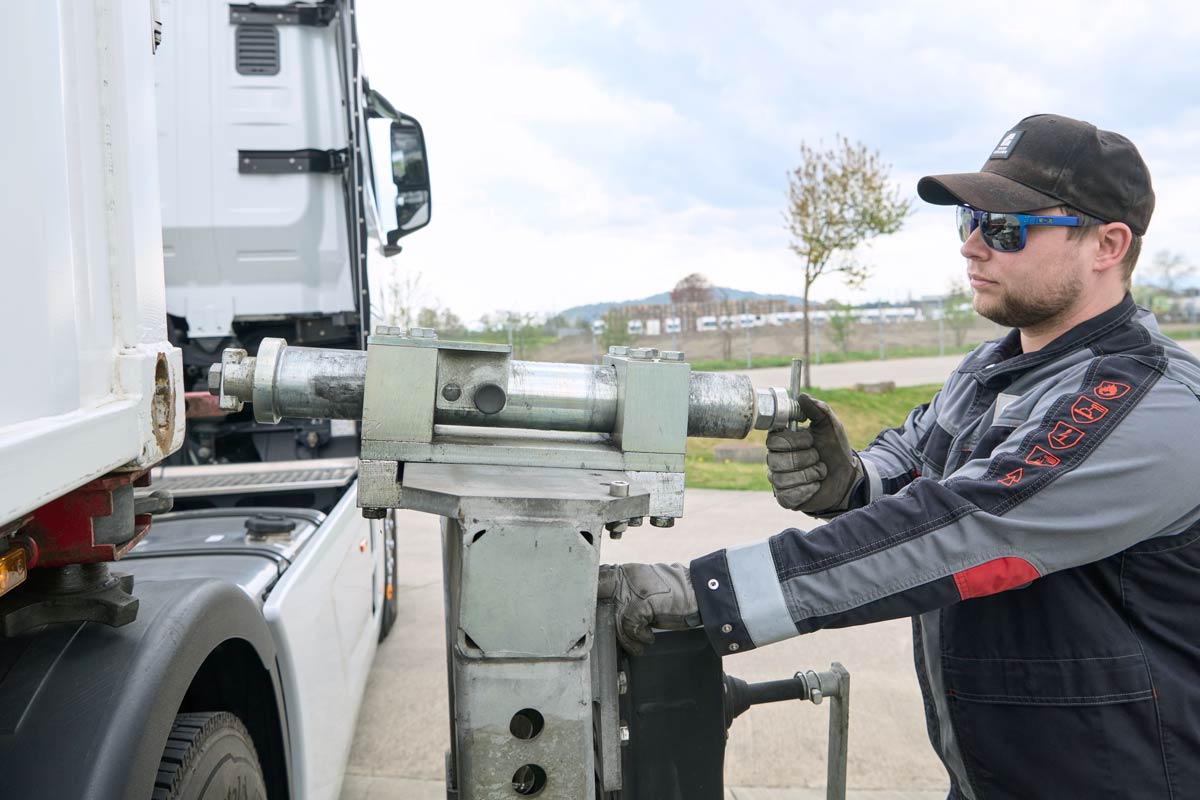
With docking stations for efficient container logistics
In many industries, containers, trailers, and loading processes are operatively inseparable. This leads to systemic inefficiencies:
- Lorries are waiting for loading or unloading slots.
- Container blocking trailers for days or weeks
- A terminal or reach stacker is necessary for every move
- If the option to decouple is missing, special vehicles are idle during maintenance, loading or unloading.
- High investments in fixed refuelling systems reduce flexibility
The result: tied-up capital, paid waiting time, limited scalability. The Container Docking Station solves these structural problems.
The docking station makes the container an independent module. Transport and storage are functionally separated.
The process is very straightforward:
- Trailer entering the docking station
- Stowage, or retrieval of the container
- Trailer exiting the docking station
The entire process takes place without a crane or terminal, without a fixed external time window and can by a single driver to be carried out independently.
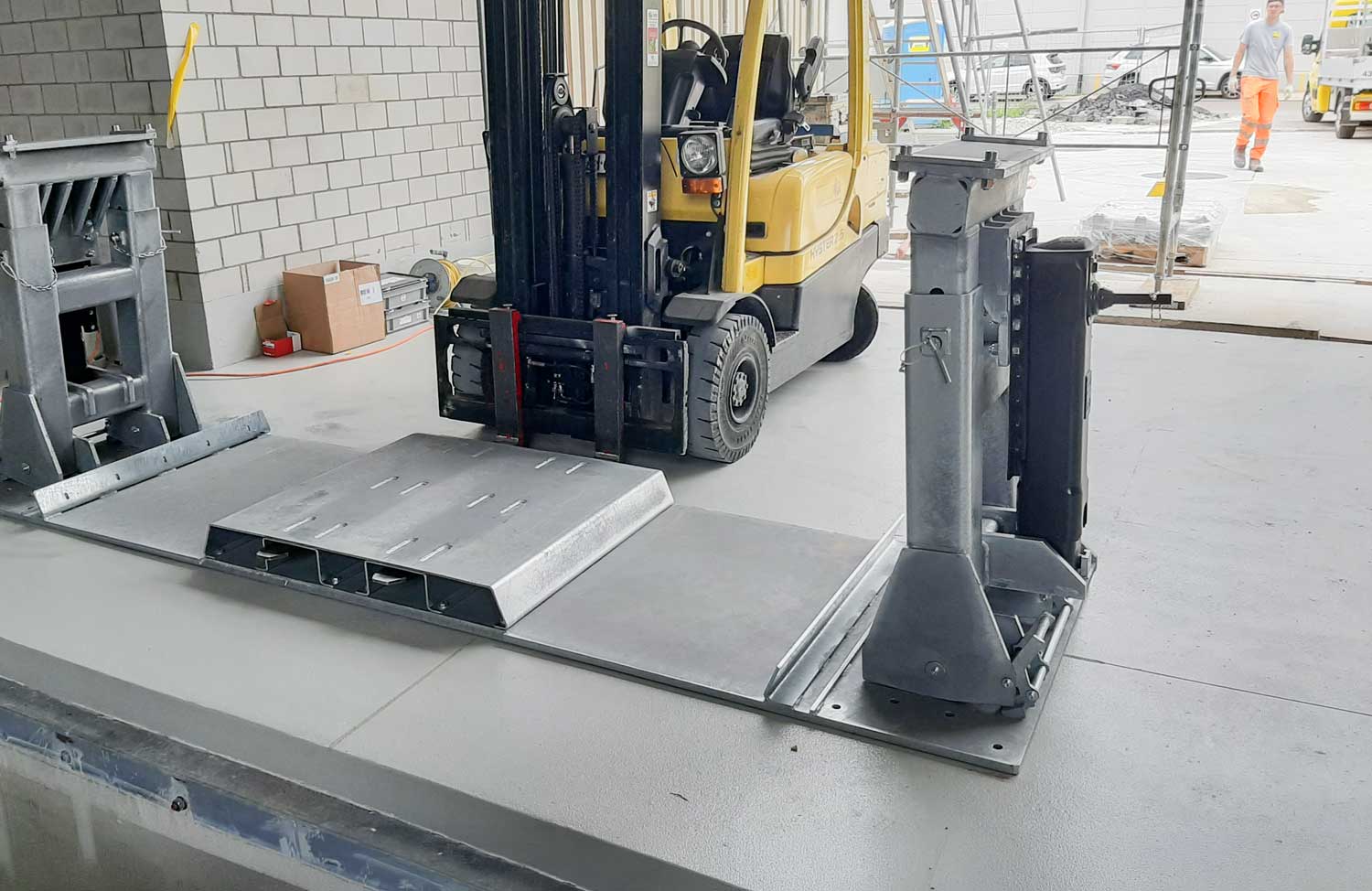
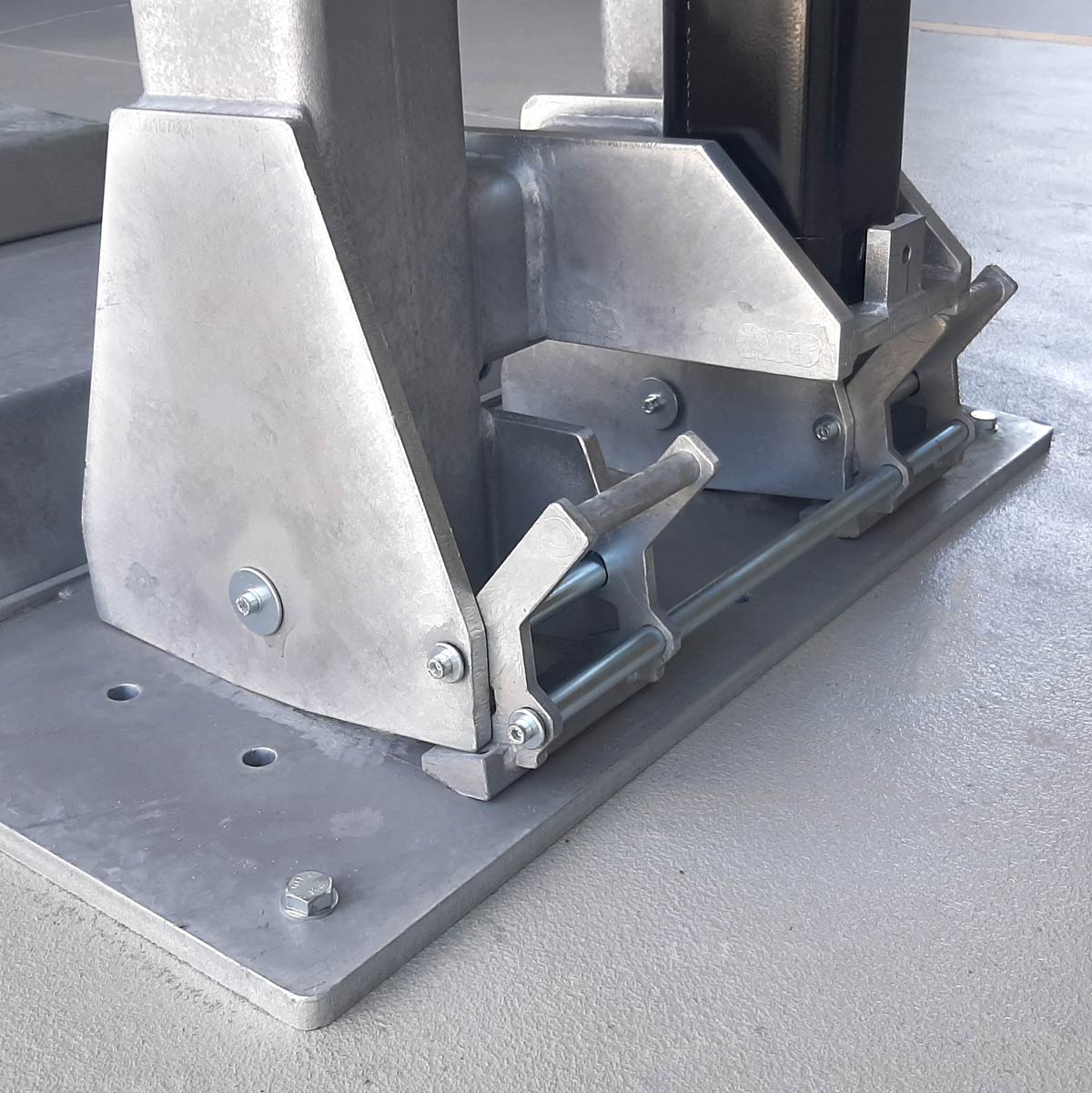
The container docking station is DEKRA-certified and ground-anchored, designed for continuous industrial use. It is available in lengths of 10’, 20’, 30’, or 40’ for containers with ISO-certified corner fittings.
Security aspects
- DEKRA certified up to 34 tonnes
- Designed to be anchored to the ground and earthquake-resistant according to Eurocode 8.
- For containers/swap bodies with standard corner fittings according to ISO 1161

Container Docking Stations – System Variants
Download product overviewArea of application Hubs, transhipment points and high-throughput interim storage facilities
Container Sizes 20', 30' and 40' (45' via 40' corner fittings)
Container recording: on the ISO-standardised corner fittings
Max. Load Capacity: 34 tonnes
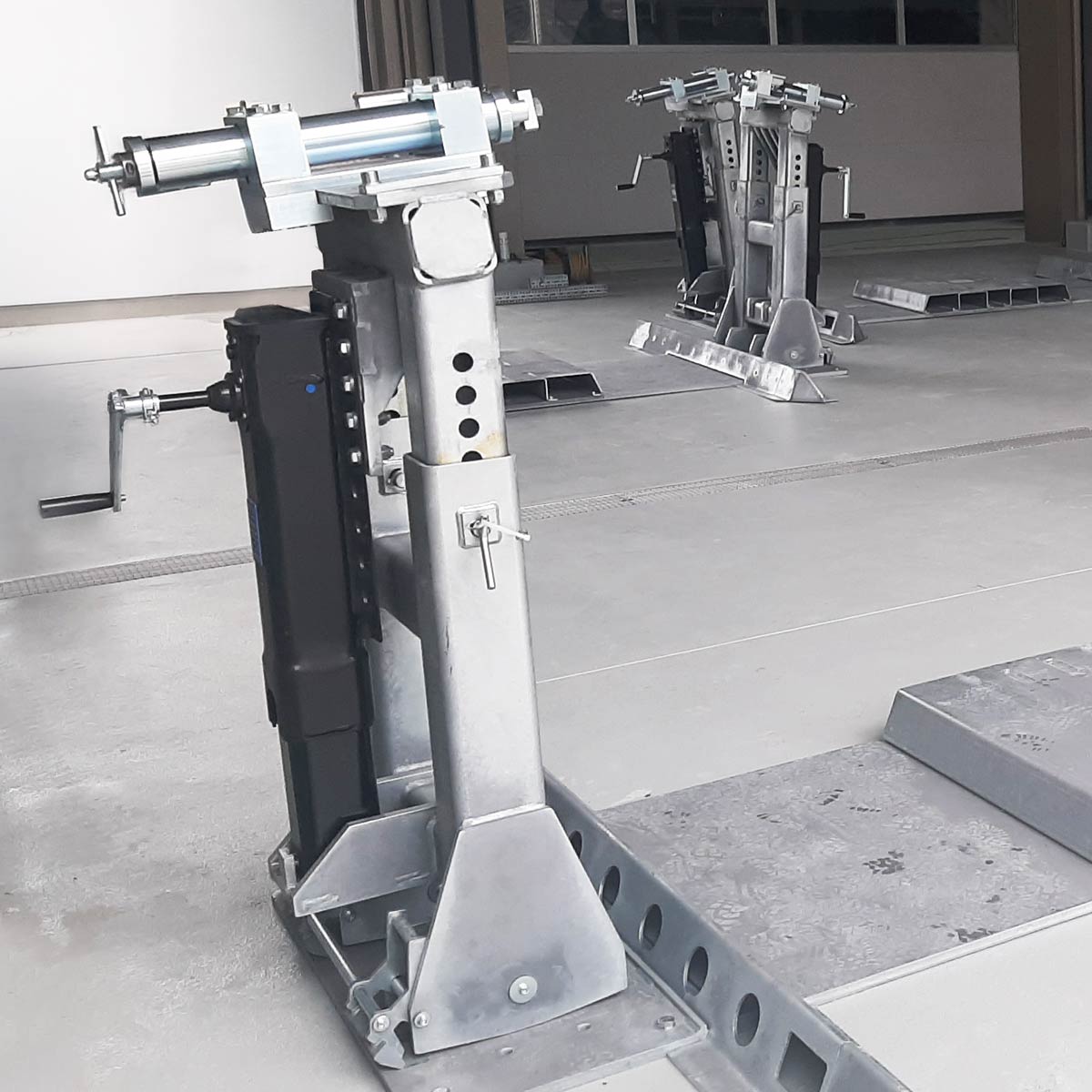
Structure four-legged stand with continuous wheel guide
Handling 1. Entry, 2. Parking or loading via the truck's air suspension, 3. Exit
Typical usage: Container-swapping processes and use in hubs
Special features Scalable modular system for growing requirements
Biggest advantage: Efficiency and safety for regular handling volumes
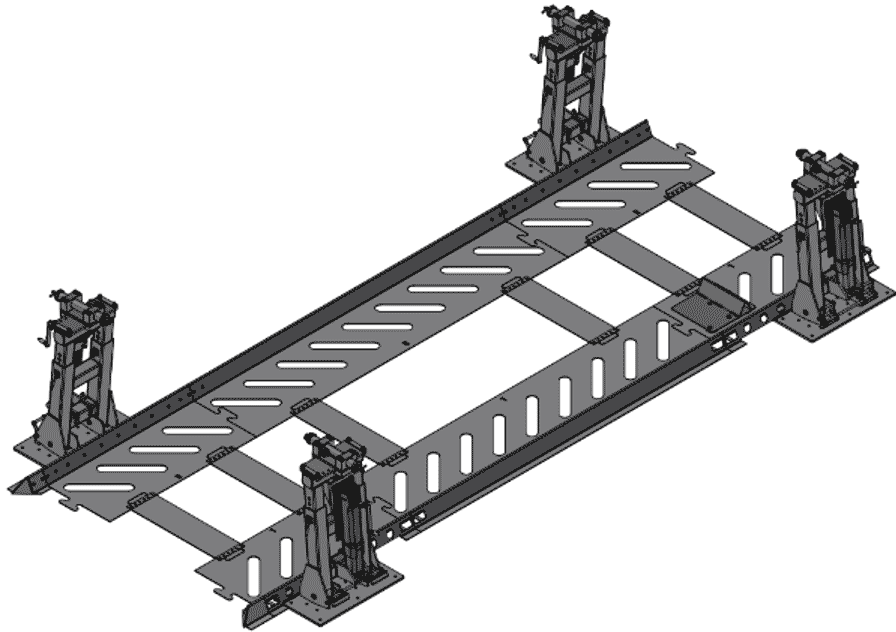
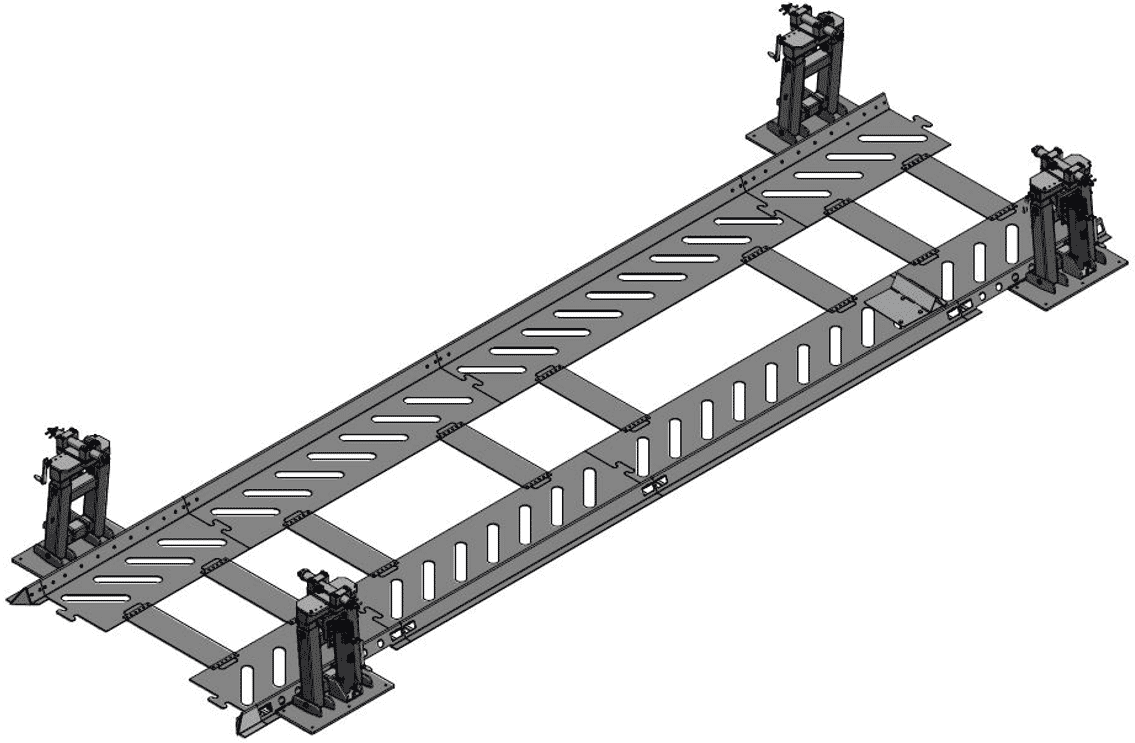
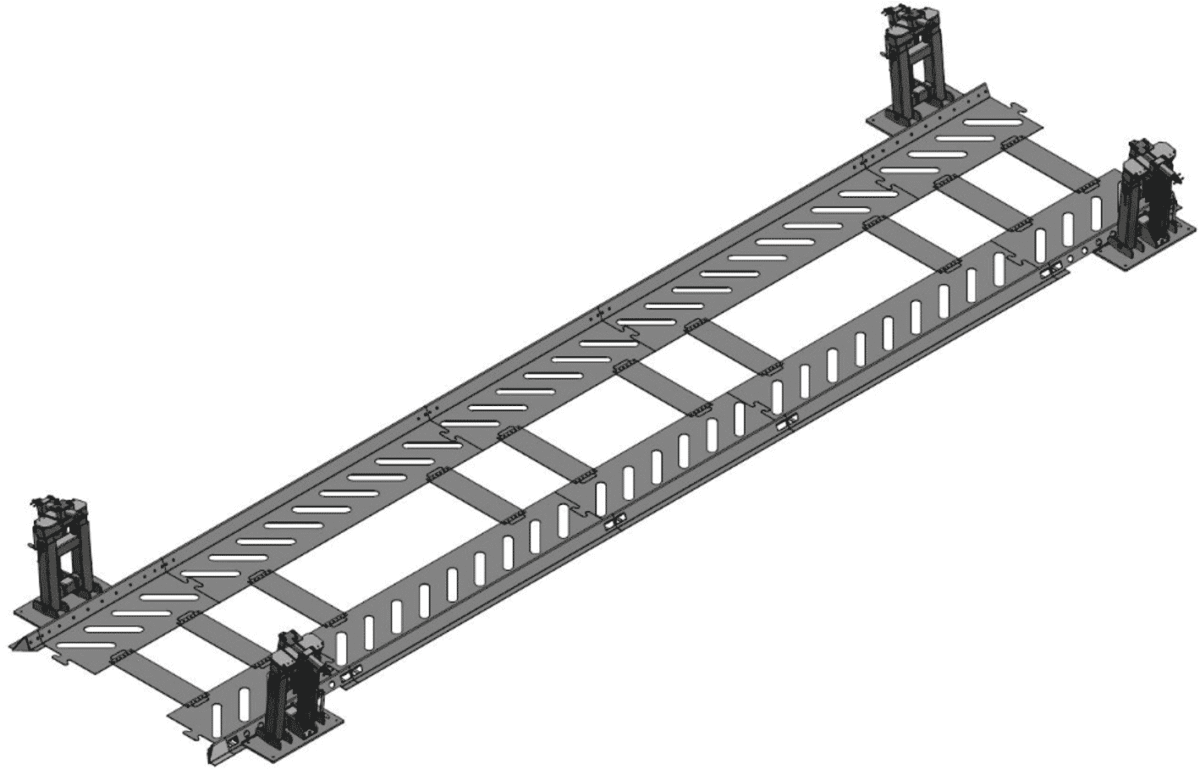
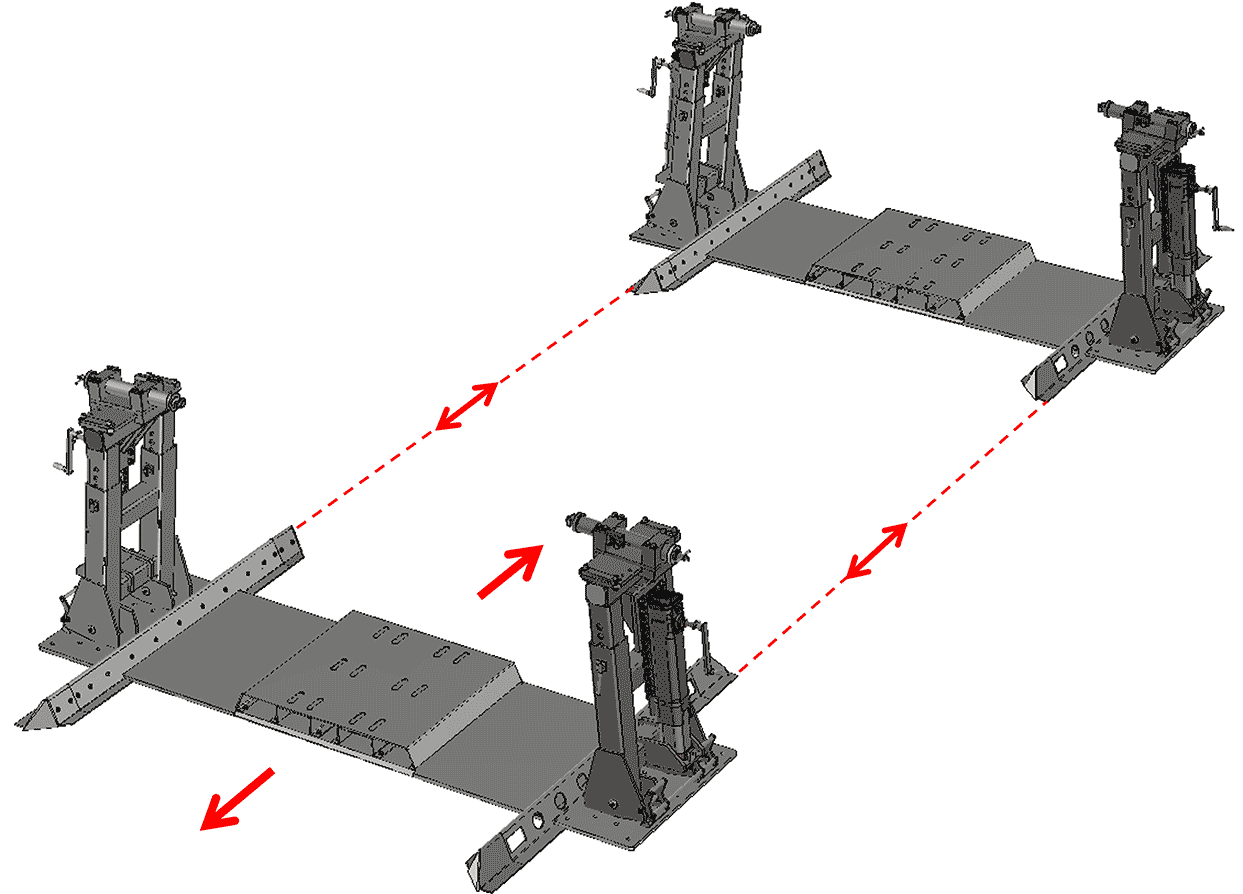
Area of application Loading ramps and flexible transshipment points with changing requirements
Container Sizes 20', 30' and 40' (45' via 40' corner fittings)
Container recording: on the ISO-standardised corner fittings
Max. Load Capacity: 34 tonnes
Structure A combination of a fixed support set (at the rear) and a mobile support set (at the front)
Handling Parking: 1. Positioning the mobile support set to the desired container length, 2. Driving in, 3. Parking the container using the truck's air suspension, 4. Driving out
Special features Easy transport of a support set (total weight 1.5 tonnes) using a pallet truck or forklift
Biggest advantage: Adjustable in length and with the option of mid-way emptying
Area of application Hubs, distribution centres and combined transport
Container type Swap-Bodies (SB) with grappler plates to European standard
Container recording: about the grappler plates of the swap body container
Max. Load Capacity: 18 tonnes (typical for swap bodies C745, C782)
Structure four floor-mounted support legs with wheel guidance
Handling 1. Entry, 2. Parking or loading via the truck's air suspension, 3. Exit
Typical usage: quick exchange of swap body containers in distribution and hub structures
Special features No need to extend or retract swap body support legs
Biggest advantage: Time savings and greater comfort for drivers
Use Cases
The container docking station offers the following solutions, amongst others.
1
Drop – simple dropping off and swapping of containers on-site
By using the docking station for the temporary intermediate storage of containers, the trailer is immediately available for further transport or maintenance. Trailers are too valuable to serve as parking spaces. Their TCO costs are significantly higher than those of the docking station. If the container remains stationary for longer, any potential trailer demurrage charges are also avoided.
It is also a benefit during maintenance or repairs on the trailer if it can be easily detached from the container.
Trailer changes under a container will also become more efficient. Instead of having to drive to a terminal or use a reach stacker, the new trailer picks it up directly on-site from the docking station.
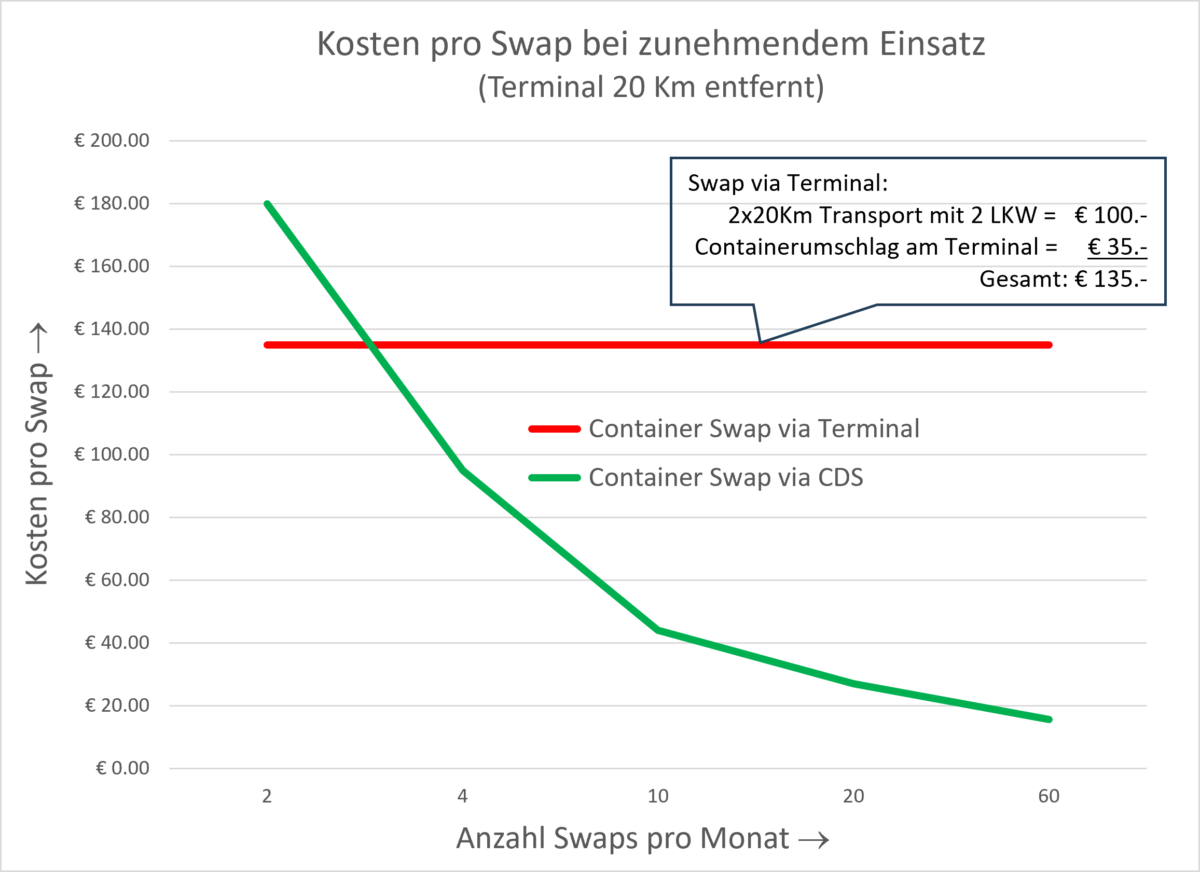
Worked example:
Cost per container swap via terminal (red)
At a terminal 20 km away, the swap must be carried out simultaneously with two lorries – one lorry brings the container, a second is ready empty. This incurs additional costs for transport (there and back) as well as for handling. In comparison, the swap can be carried out much more efficiently on your own yard with a docking station in just 15 minutes.
Cost per container swap docking station (green)
If you carry out a chassis change directly and autonomously on your site, instead of traveling with two lorries to the terminal 20 km away, you will already achieve cost savings from the CDS at 3 swaps per month (see graphic). Furthermore, the CDS solution is significantly simpler and more flexible in operation.
Cost-relevant factors:
- Saving terminal fees
- Logistics cost reduction
- Faster response times
Strategic Advantages:
- Greater flexibility in fleet management
- Third-party supplier independence
Calculation examples are based on assumptions *
2
Swap / Hub & Spoke – exchanging full for empty containers
Docking stations are excellent for container swaps, meaning you drop off one container and immediately pick up another from a nearby docking station. Usually, an empty container is swapped for a full one. This requires two docking stations.
Furthermore, docking stations enable the establishment of a company-owned hub-and-spoke system with a clear separation of long-haul transport and local distribution.
Example LNG Distribution:
A standard chassis truck transports a full LNG container from the LNG terminal to the regional hub and places it in a docking station. There, an LNG trailer with a pump installation takes over for local delivery. After delivery, the trailer returns the empty container to the docking station, where the standard truck picks it up for the return journey to the terminal.
This way, the trailer with the expensive cryogenic pump can fully concentrate on local distribution, while the standard container truck efficiently handles the long haul to the LNG-terminal. At the same time, drivers gain additional flexibility as they can drop off and pick up containers independently at times that suit them.
Worked example:
In relation to an amount to be distributed annually 5,000 tonnes of LNG and a 500 km away Terminals are without local hubs at least Five pump chassis continuously in use.
With a local hub of three Container Docking Stations the same volume can be handled significantly more efficiently: Two standard chassis take over the transport from the LNG-terminal to the hub, while after the swap on the hub two pump chassis ensure the distribution to customers in the region. This allows the expensive delivery vehicle to be used much more efficiently, leading to a significant reduction in overall operating costs – With the CDS-Hub, TCO costs are over €100,000 lower.
Cost-relevant factors:
- Reduction of required pump chassis (from 5 to 2)
- Higher utilisation of the expensive delivery vehicles
- Lower transport costs through optimised use of chassis
- Fewer empty journeys and downtimes
Strategic Advantages:
- Additional local storage capacity
- Safety aspect: no reloading/re-pumping of the product
Calculation examples are based on assumptions *
3
Drop & Swap – flexible interim storage of transport-ready containers
Docking stations are ideally suited for so-called drop & swap processes, as well as for flexible interim storage of containers that are ready for transport. They enable containers to be made available or collected independently of fixed time windows, thereby decoupling transport from on-site operational processes.
If hauliers are forced to wait at a worksite because loading or unloading takes too long during operating hours, this not only incurs additional costs but also causes unnecessary hassle and stress.
This situation can be significantly eased with (tank) containers and docking stations. The addition of parking spaces for empty and full containers decouples transportation from loading and unloading processes. Already loaded containers can be prepared in docking stations and collected by the transporter at a later, freely chosen time (exchange of full for empty). Transporters can carry out this process independently, without fixed time slots, and simultaneously with colleagues doing the same.
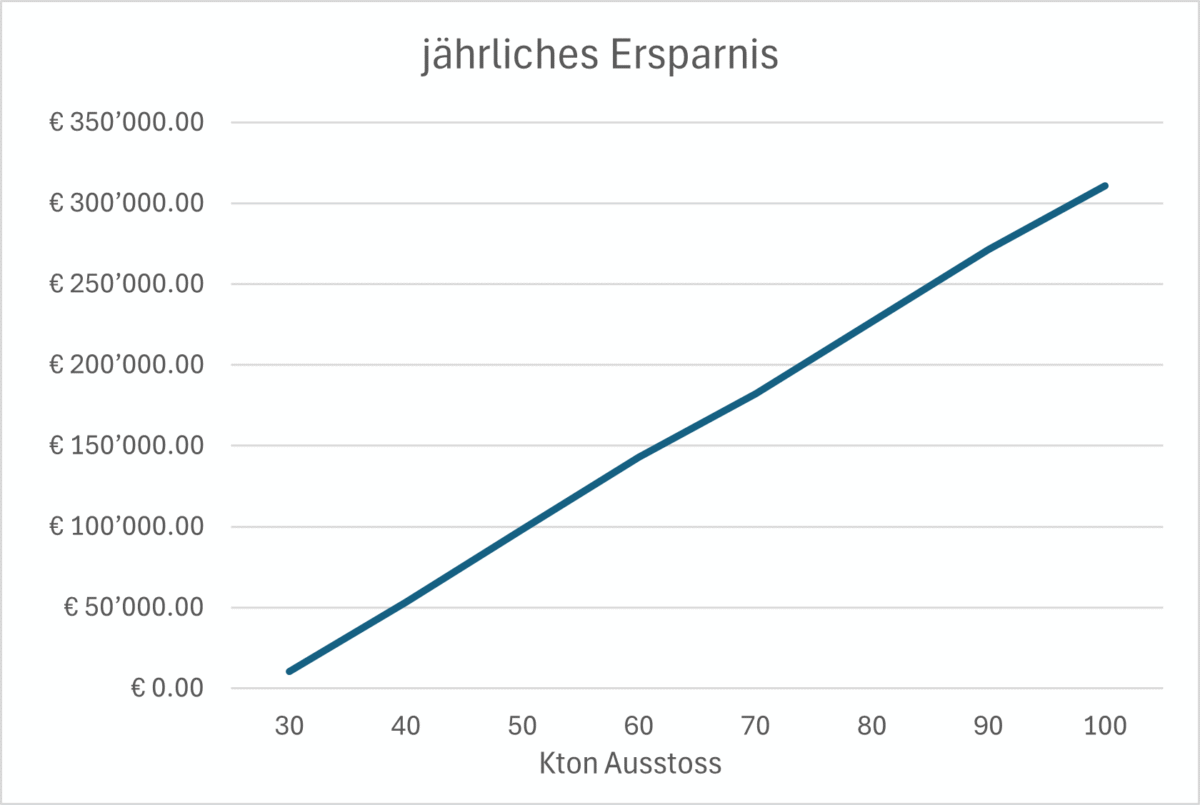
Worked example:
In a 24/7 production process with loading times exclusively during the day, transporters regularly experience waiting times of an average of 2.5 hours per vehicle. At an assumed cost of €90 per hour, the waiting times alone add up to €225 per lorry. By using docking stations in a 'drop and swap' operation, these waiting times can be completely avoided, as containers can be delivered and collected independently of loading times. This not only eliminates the additional costs for trucks and drivers but also ensures significantly better planning and smoother operations at the plant.
Cost-relevant factors:
-
Elimination of waiting times and associated costs for lorries and drivers.
-
Decoupling of transport and charging processes for more efficient operations
-
Reduction of peak times and operational pressure in the plant
-
Improved planning and scheduling
Strategic Advantages:
- Stress-free loading thanks to pre-work
- Satisfied logistics partners
- Additional buffer capacity to absorb fluctuations
- Safety aspect: no reloading/re-pumping of the product
Calculation examples are based on assumptions *
4
Drop & Connect – precise container positioning
For certain applications, it is crucial that containers are repeatedly placed in exactly the same position – for example, during loading and unloading via quick couplings or during top loading via manhole covers.
Docking stations enable precisely this level of accuracy: thanks to integrated floor guidance and permanently mounted supports legs, the container is positioned reliably and always in the same place. Additional elements such as plastic plates on the wheel guide or mechanical stops on the couplings can be used to further refine the positioning and tailor it precisely to the respective requirements.
Cost-relevant factors:
- Reduction of shunting effort and time for trucks
- Minimising misalignments and subsequent damage or correction costs
Strategic Advantages:
- Even if containers are brought with different chassis, they are always positioned in exactly the same way.
Calculation examples are based on assumptions *
Disclaimer regarding calculation examples: All calculations on this website are for estimation purposes only. They are not legally binding and do not constitute an offer. We have produced them based on assumptions made to the best of our knowledge and belief.
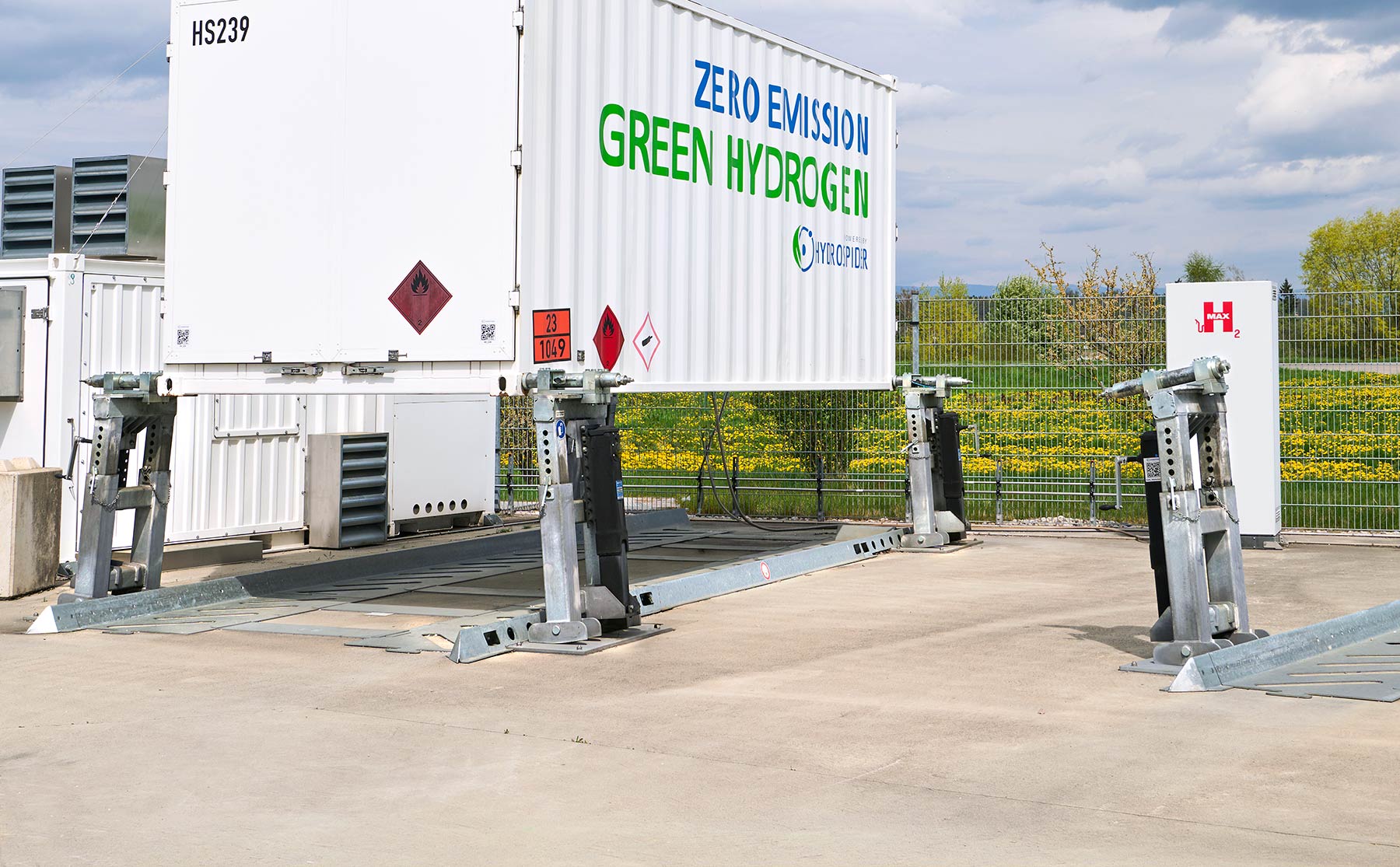
Einfacher Wechsel von Wasserstoffcontainern mit der Container Docking Station
At Hydrospider AG, our container docking stations have been an integral part of our hydrogen logistics concept for years.
Hydrospider focuses on the production, distribution and trading of hydrogen produced entirely from renewable energy. We call it the “H2 Ecosystem”.
We have made the Container Docking Stations of InnovaTrain an integral part of our H2-distribution, as the CDS make our supply chain fast, safe, and economical.
From 2020 on, Hydrospider and our Ecosystem partners already did over 8’000 hydrogen container swaps via the Docking Stations without any incidents or problems. We are very satisfied with this product”.

Corey Houle
CEO of Hydrospider AG

















We would be happy to advise you on your individual container docking station concept and calculate your savings potential.
Arrange a consultationIn a consultation, we will analyse together:
- Your current and future logistics processes and your vehicle fleet
- The use of (tank) containers in your logistics
- Downtime and capital tie-up in your current logistics
- Dependencies of terminals
- Development of an optimal solution with CDS
- Scalability potential